
by Dren Puka | 06.08.2026 | K2.0
In late July, the Municipality of Prishtina’s decided to terminate BIRN Kosovo’s contract to use premises in the Grand Hotel — home to the Reporting House museum — and cut funding for the project. This decision brought back into focus an unresolved question: what happens to public property when the discretion of those in power takes the place of rules and the public interest?
This question also arose in 2024, when a group tasked with amending the Law on the Leasing of Municipal Public Property in 2024. At the time, the biggest debate was not about public property itself, but about who controlled it. Civil society organizations demanded that public property be made available for use through open procedures and clear, inclusive criteria. Meanwhile, the Association of Kosovo Municipalities (AKM) insisted that municipal mayors retain as much discretion as possible, while the Ministry of Local Government Administration (MLGA) was less convinced that civil society organizations should also have access to the public realm.
At first glance, this seemed like a technical disagreement about efficiency and sound management. In reality, it was a conceptual clash: who does the public realm belong to, and who should decide how public property is used and for what purpose?
Public resources cease to be truly public the moment the authorities begin using them to reward the obedient and discipline everyone else. Office space, a grant or a permit to use a public square may seem like minor administrative matters. But when access to them depends on whether an organization pleases, criticizes or angers those in power, they become instruments of control. The message is that public resources remain available only for as long as one’s relationship with those in power remains acceptable. Without clear procedures and accountability, that “acceptability” comes down to an ad hoc, subjective judgment by those in power.
Public property belongs neither to the mayor nor to the party that runs the municipality. It belongs to the citizens, including those who oppose the authorities and hold them to account. Public institutions merely manage it temporarily, under the mandate entrusted to them. But that mandate does not give them the right to decide who should be rewarded and who should be punished.
Using power as a tool of discipline
The immediate controversy began in late July, around the anonymous Facebook profile “Lule Gjeli,” which for years spread disinformation and hate speech on Facebook, including against the Mayor of Prishtina, Përparim Rama. At the time, the media reported that the same name had been used as the byline for an article published by KALLXO.com in 2020 — a platform jointly run by BIRN Kosovo and Internews Kosova, among others. Within hours, the issue had become one of the main topics of public debate.
This prompted Rama to publicly demand explanations from BIRN Kosovo and KALLXO.com about the matter. He even warned that unless he found the answers satisfactory, he would reconsider all forms of institutional cooperation with the organization. Rather than communicating his questions directly to the organization, he posted them on his personal Facebook account as a public ultimatum.
A few days later, BIRN Kosovo provided its explanations; nevertheless, the agreement granting its use of the space was terminated. It appears that, for the municipal authorities, those explanations were not “satisfactory.”
Many will focus on whether KALLXO.com was right to publish an opinion piece under a pseudonym. Others will defend that decision. Some will consider Rama’s questions reasonable; others will not. These are legitimate dilemmas. But the more fundamental issue is this: should access to public property and resources depend on an organization’s relationship with the authorities at any given moment?
Everyone is free to criticize a media outlet’s reporting. But when that criticism comes from someone in a position of power, how it is exercised matters.
It is precisely here that power begins to be used as a tool of discipline, and public property starts to lose its public character.
A mayor or any other senior official cannot take action against a media outlet or civil society organization simply because of the work it does. Neither media outlets nor civil society organizations — which, in this case, are one and the same — are required to prove their innocence every time the authorities cast doubt on their work. If there are grounds to suspect a legal violation, that is for the competent institutions and courts to assess –– not an individual official, and certainly not through a mayor’s Facebook post.
It is precisely here that power begins to be used as a tool of discipline, and public property starts to lose its public character. This becomes even more worrying given the mayor’s warning that he would review all contracts the Municipality of Prishtina has with civil society organizations. Nor was this the first time he has made such a threat.
Kosovo has a history of municipal property being handed over to businesses in violation of the law and without transparency, in cases that have led to investigations, indictments and convictions of senior public officials, including municipal mayors. Yet mayors rarely publicly threaten to review all their contracts with businesses. We rarely hear them ask whether the property is still being used for its intended purpose or whether the business is fulfilling its contract. This zeal, however, emerges far more quickly when the other party is a civil society organization.
Institutions should monitor their own contracts and are entitled to review them to ensure they are carried out in accordance with the agreement and in the public interest, while also meeting their own obligations to the entities using those spaces. But such oversight must be regular, planned and based on criteria that apply equally to everyone. When such oversight instead comes at the height of a public confrontation with an organization and immediately after cooperation with it has been terminated, it reads as a public threat. The message is not directed only at BIRN; it is directed at every organization that uses municipal space, receives public support or cooperates with the municipality.
This approach has nothing to do with responsible governance or with protecting public resources. Public property does not belong to the mayor, and it will still be there when his term ends. The point is so self-evident that it should hardly need saying.
One could argue that this is only about an office and project funding; that BIRN can find another space or donor; that no one has been denied a fundamental right. Perhaps.
But this issue is not really about an office.
Freedom of action is rarely lost in a single decision or moment.
Imagine you run a civil society organization — a cultural center, a theater or any other organization that uses municipal space. One day, you publish critical research, organize a debate that the authorities dislike or challenge a municipal decision.
Would you hesitate, even for a moment? Would you start to feel that your relationship with the municipality now carries a weight it did not have before, and that you need to tread more carefully?
Freedom of action is rarely lost in a single decision or moment. It usually begins to shrink through small actions until a pattern takes shape. A paragraph is rewritten. A public reaction is not endorsed. An activity is not organized. Another is renamed because its title does not suit those in power, while government officials become the centerpiece of every event. Gradually, a pattern takes hold, quietly conveying the message: “Maybe now is not the right time.”
From the outside, it may look as though nothing has happened. Yet the space for independent action has already begun to shrink. That is precisely why this case should not be treated as an isolated incident. The pattern feels familiar and demands attention and a response.
Earlier this year, the Youth Initiative for Human Rights (YIHR) found itself at the center of public attacks after organizing a series of lectures on Kosovo’s justice system — including the Kosovo Specialist Chambers in The Hague — at Xhevdet Doda High School in Prishtina. The circumstances were different, but the municipality’s response was not. Once again, attention quickly shifted away from the substance of the issue and questions of institutional responsibility, and toward the organization itself, which was, among other things, threatened with punitive measures by the Municipality.
When a controversy arises, the first reaction is not always to establish a procedure and take responsibility. It is to intervene.
A few months later, Rama suspended the permit for the “Massacres in Kosovo 1998–1999” exhibition, organized by Admovere and Integra in Mother Teresa Square. The exhibition had drawn criticism for inaccuracies in how it portrayed some of the massacres committed in Kosovo during the last war. Rather than addressing the situation through a clear procedure — and with particular care and responsibility, given that it concerned one of the most painful chapters of Kosovo’s history — Rama announced its immediate suspension in a Facebook post. The exhibition was quickly removed from the capital’s main square. At that moment, the municipality assumed the role of prosecutor, judge and police. Again, the circumstances were different, but the approach was the same.
A complex debate about history, facts and public responsibility was once again displaced by direct intervention from local government in the use of public space. Rama decided what could remain on display in the square and what had to be removed.
When a controversy arises, the first response is not always to establish a procedure and take public responsibility. It is to intervene. The organization is targeted, its permit is suspended, its contract is reviewed and, eventually, its space taken away.
One case can be seen as an isolated incident. But three cases require us to ask whether a pattern of governance is taking shape.
We do not need more discretion
Not every decision is necessarily driven by bad intent. The problem is that too much can depend on the personal judgement of whoever is in power. This is precisely why rules exist: so that the public interest does not shift according to the will of one individual.
It is no coincidence that the Law on Freedom of Association in Non-Governmental Organizations sets out a few basic principles governing the relationship between public institutions and civil society organizations.
Public institutions must create conditions in which civil society organizations can operate freely, treat them equally and without discrimination, and refrain from interfering in their activities. These legal guarantees are just one way the rule of law seeks to protect civil society from the arbitrary exercise of power.
There is another truth that needs saying.
The problem did not begin when BIRN’s agreement was terminated. It began much earlier: this public space was itself allocated through an arrangement that only became clear after the fact.
If public property is allocated at the discretion of those in power, then losing access to it can depend just as heavily on that same discretion. We have seen this repeatedly over the years. We solve nothing by defending one arbitrary decision against another. Nor do we solve anything by remaining silent because of the original sin.
It is precisely for cases like this that rules and accountability mechanisms exist.
For years, we have called on the Government of Kosovo to establish clear, transparent and inclusive rules governing the use of public property. This demand has too often failed to receive the attention it deserves –– from either side.
The MLGA had a golden opportunity to address this issue in 2024, during the process of amending the law, but failed to do so. Following objections from civil society organizations and the intervention of the then-Speaker of the Assembly of Kosovo, Glauk Konjufca, a version of the law that failed to provide adequate solutions — and in fact risked deepening the very problems discussed here — was successfully blocked. But the underlying problem remained.
In September 2024, seeking a way forward, a group of civil society organizations proposed to Rama a detailed process for bringing the former Hivzi Sylejmani Library back into use. The proposal called for community consultation and participation, a clear definition of the space’s purpose, an open and criteria-based process, equal access, public selection, oversight and accountability. The mayor agreed in principle with this approach, but the process has yet to begin.
We do not need more discretion.
Rules and accountability exist for this reason: to ensure that public property and public resources are allocated in ways that serve the public interest, not because an organization is on good terms with those in power.
The cases of BIRN, KALLXO.com, YIHR, Admovere and Integra reveal the absence of a consistent approach to managing public resources. Instead, decisions are made under the pressure of day-to-day debates, through hasty reactions and direct interventions by those in power.
Public space cannot remain public only for as long as what happens in it is acceptable to those in power. It is also misused when it becomes a tool for deciding who may speak, what may be exhibited and which critical voices still deserve a place in the city.
Our cities need more spaces where people can meet, organize, create, challenge those in power and take part in public life. Property that is kept locked up, allocated behind closed doors without transparency, or controlled according to proximity to power, does not serve the public.
The public realm becomes truly meaningful when different communities and citizens can use it or benefit from it, and when decisions about its use are made through fair, transparent rules centered on citizens’ needs.
That requires sustained engagement from all of us — not only when an office is taken away or a permit revoked, but every time a decision is made about who the city belongs to and how its public spaces are used.
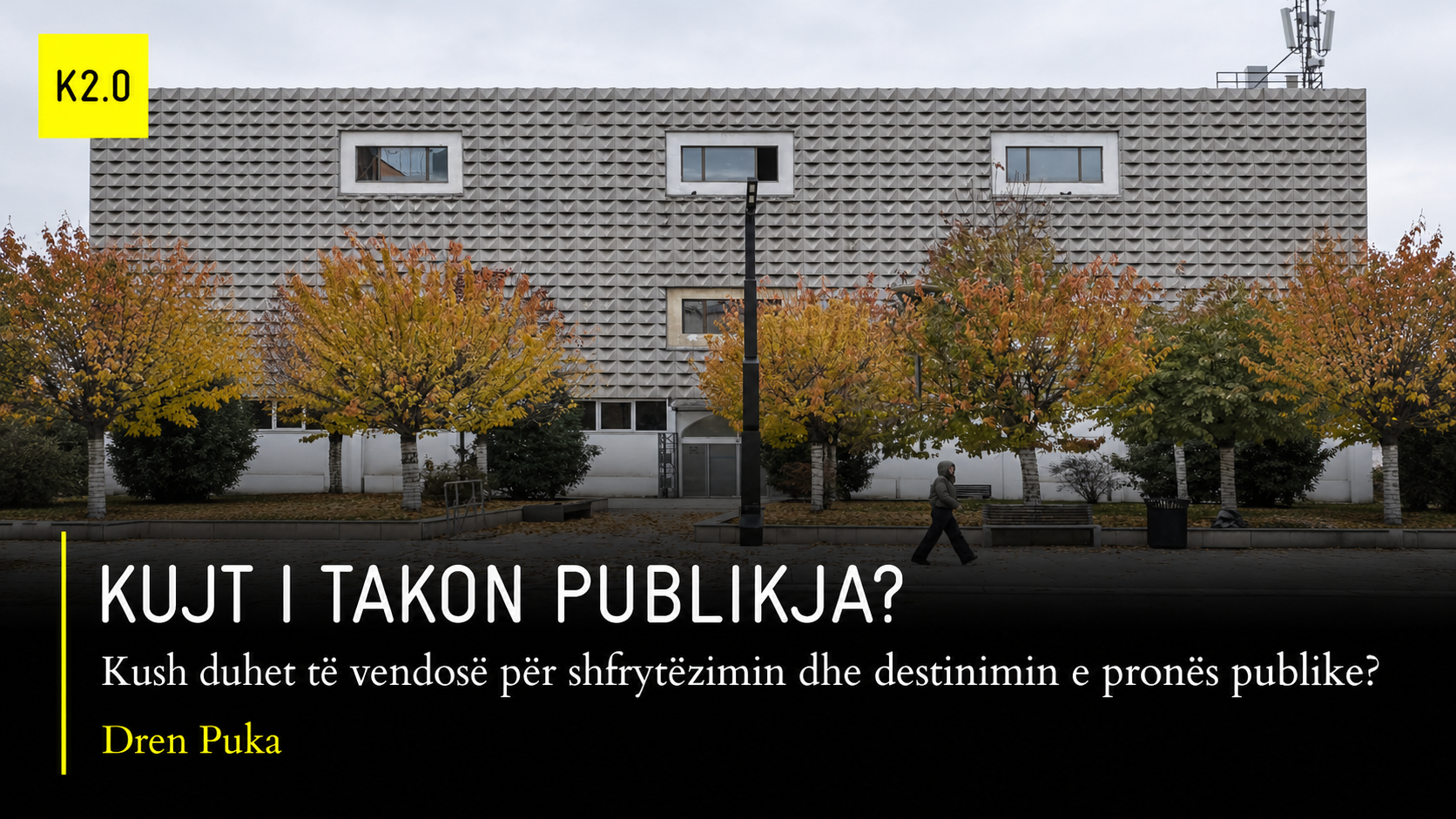
Feature image: Ferdi Limani / K2.0
