
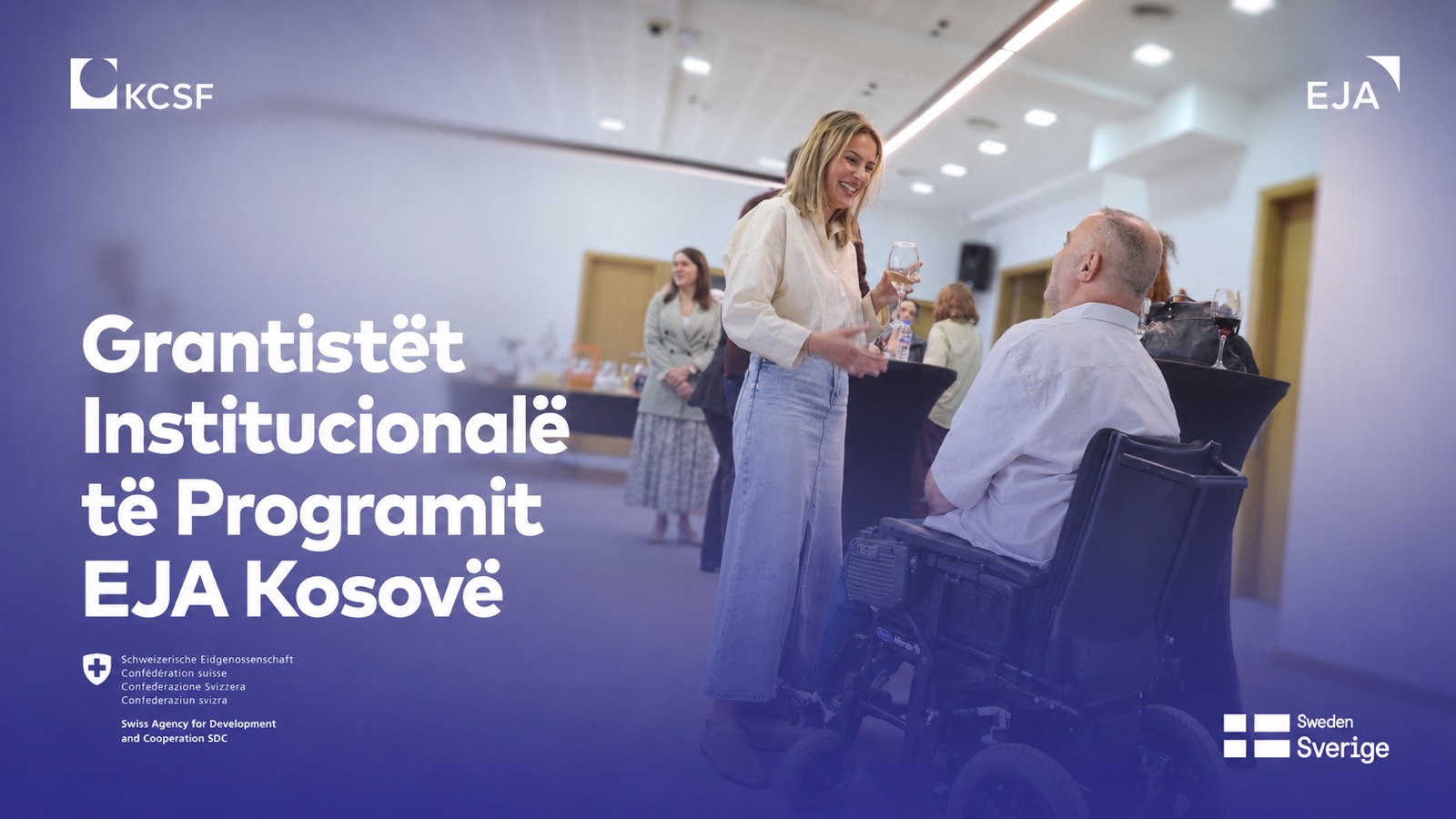
At KCSF premises, we met with 17 Institutional Grant beneficiary organizations from the two cycles of this support instrument, bringing together organizations that have already completed the first year of implementation with those that have just begun their three-year journey of institutional support. The meeting created space for introductions, dialogue, and networking among organizations that work every day to give citizens in Kosovo a stronger voice.
In his remarks, KCSF Executive Director, Mr. Dren Puka, emphasized the importance of long-term and flexible support for civil society organizations as a prerequisite for their sustainability, independence, and impact on the democratic development of the country:
“Across Europe, civic space is narrowing. Not by accident, but by deliberate political choice. In this context, the institutional support KCSF provides is more valuable than ever: it offers flexibility, time to think strategically, and space to build genuine trust with citizens. Organizations that are truly rooted in the communities they serve are stronger, more resilient, and far harder to attack or delegitimize, and that is the most sustainable form of defending democracy.”
The importance of supporting civil society as a key pillar of democracy was also reaffirmed by Mr. Henrik Riby, Head of the Swedish Development Cooperation Agency in Kosovo:
“A vibrant and diverse civil society is crucial for a prosperous democracy. This is why Sweden support KCSF and their partners who are contributing to the development of Kosova by advocating for human rights to be protected and realized for all citizens.”
Ms. Beate Kajta Elsasser, Head of Cooperation at the Embassy of Switzerland in Kosovo, also underlined Switzerland’s continued commitment to supporting civil society:
“The recently launched Swiss Cooperation Programme with Kosovo (2026 to 2029) reaffirms that support to civil society remains an important focus of our engagement. We continue to believe that strong, independent, and credible civil society organizations are essential for democratic development, social cohesion, accountability, and informed public debate.”
The beneficiary organizations of the first cycle, which have completed the first year of implementation, are: Kosovo Glocal / Kosovo 2.0, QIKA Institute, Kosovo Talent and Education Center – TOKA, GAP Institute, Organization for Improving the Quality of Education – ORCA, Center for Affirmative Social Actions – CASA, Foundation Shtatëmbëdhjetë, and Lumbardhi Foundation.
The beneficiary organizations of the second cycle, which have started implementation this year, are: Teach for Kosova, Institute for Social Policy “Musine Kokalari”, Group for Legal and Political Studies – GLPS, Kosovo Rehabilitation Centre for Torture Victims – KRCT, Center for Social Group Development – CSGD, Center for Information and Social Improvement – QIPS, Handikos Ferizaj, NGO Aktiv, and Democracy for Development – D4D.
Institutional Grants aim to support the implementation of organizational strategies while simultaneously strengthening internal capacities, enabling organizations to represent citizens’ interests in their respective thematic areas and to respond in a timely manner to evolving needs in these fields.
Institutional Grants are part of KCSF’s EJA Kosovo program for civil society support, co-financed by the Swiss Agency for Development and Cooperation and Sweden.
