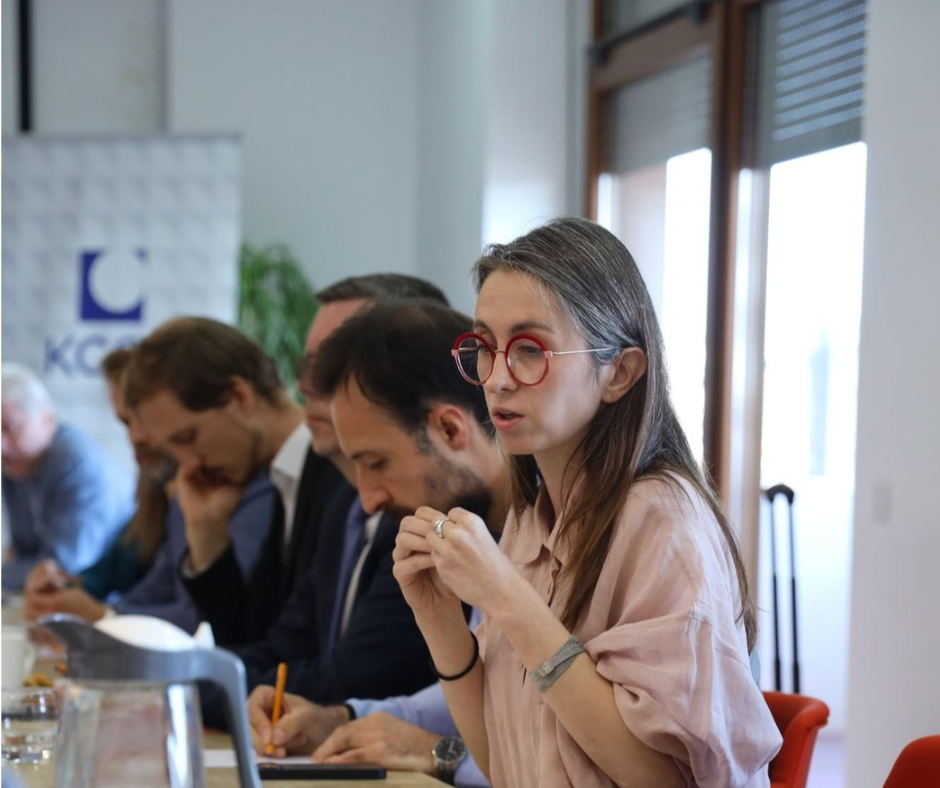
On 2 October, the Enlargement Strategic Dialogue concluded in Prishtina with the working discussion “𝐄𝐧𝐥𝐚𝐫𝐠𝐞𝐦𝐞𝐧𝐭 𝐀𝐟𝐭𝐞𝐫 𝐭𝐡𝐞 𝐆𝐞𝐨𝐩𝐨𝐥𝐢𝐭𝐢𝐜𝐚𝐥 𝐌𝐨𝐦𝐞𝐧𝐭: 𝐂𝐚𝐧 𝐄𝐮𝐫𝐨𝐩𝐞 𝐒𝐮𝐬𝐭𝐚𝐢𝐧 𝐏𝐨𝐥𝐢𝐭𝐢𝐜𝐚𝐥 𝐌𝐨𝐦𝐞𝐧𝐭𝐮𝐦?”, bringing together foreign ministry officials, experts and civil society representatives from several European countries and Kosovo.
The discussion featured contributions from Bianca Fluck, German Federal Foreign Office; Fiona Gundacker, Austrian Federal Ministry for European and International Affairs; Antoine Michon, French Ministry for Europe and Foreign Affairs; Matti Nissinen, Ministry for Foreign Affairs of Finland; and Petr Tůma, Czech Ministry of Foreign Affairs. Stefan Lehne, Carnegie Europe, and Lura Limani, Open Society Foundations, joined as discussants, with Florent Marciacq, Austro-French Centre for Rapprochement in Europe and Ifri, chairing the session.
The discussion focused on how the current political context in European capitals are shaping national positions on enlargement, and how the EU can sustain political momentum as enlargement becomes increasingly connected to debates on security, migration, institutional reform and the EU budget.
Donika Emini Ph.D., Balkan Research Institute, closed the session and the three-day Dialogue. Over three days, the programme brought together public debate, institutional meetings, visits and expert exchanges on European perspectives towards EU enlargement and the links between geopolitics, regional security and the energy transition in the Western Balkans.
The Enlargement Strategic Dialogue was organised by Kosovar Civil Society Foundation (KCSF), Österreichisch-Französisches Zentrum – Centre Franco Autrichien, Balkan Research Institute and Ifri – Institut français des relations internationales, with the support of Open Society Foundations | Western Balkans, Austrian Embassy in Prishtina and Embassy of Sweden in Pristina.