
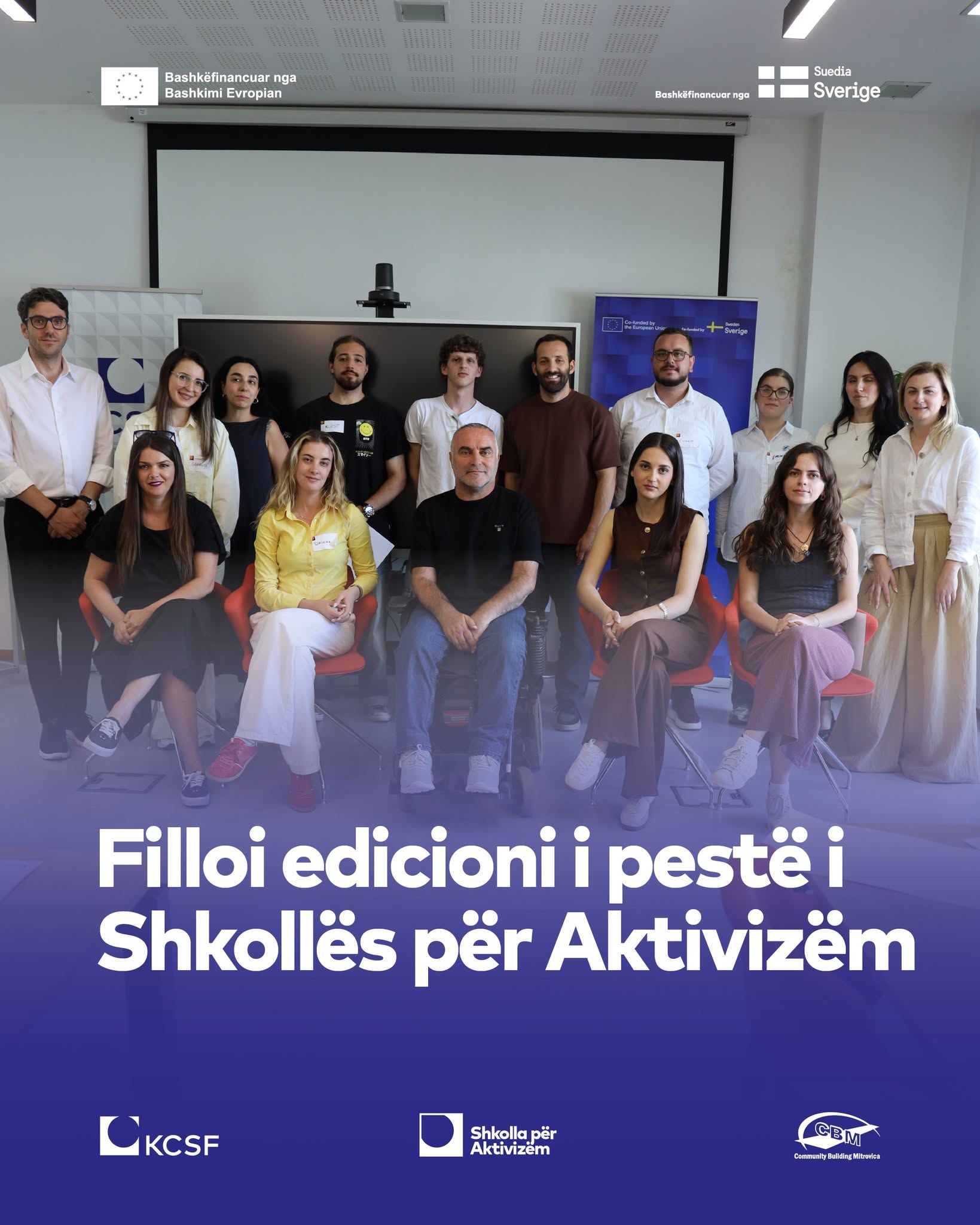
The School of Activism launched its fifth edition, bringing together 20 civil society organizations from Kosovo in a shared journey of learning, experience-sharing, and organizational strengthening.
The role of civil society is essential for a democratic, accountable, and inclusive society. Through its engagement, civil society represents the public interest, encourages civic participation, and holds institutions accountable. To fulfil this role effectively, NGOs need sustainable structures, responsible decision-making, and internal mechanisms that strengthen public trust.
In this context, the School of Activism provides a space where practical experience is linked with professional knowledge, where the everyday challenges of work are discussed openly, and where participants develop their capacities, helping the organizations they work for become more sustainable, more accountable, and more effective in serving the communities they represent.
The fifth edition consists of six thematic modules, while over the past two days we began the journey with Module 1: Internal Governance for CSOs.
This session was delivered by the Executive Director of KCSF, Mr. Dren Puka, addressing some of the most important issues for the functioning of every organization, related to how decisions are made, who bears responsibility, how the roles of governance and management are divided, and how mechanisms are built to keep the organization oriented towards its mission.
Through the lecture, discussions, and practical examples, participants reflected on how organizations can build clearer systems of decision-making, oversight, and accountability. They also gained a deeper understanding that organizational development is not a one-time process, but continuous work that requires reflection, adaptation, and responsible decisions.
Meanwhile, the legal expert, Mr. Florent Spahija, addressed the issue of preventing conflicts of interest, discussing the distinction between private interest and public/organizational interest, the risks that may arise in recruitment, procurement, or programme implementation, as well as the importance of clear rules, self-assessment, and internal control mechanisms.
The School of Activism is organized within the framework of the Resource Centre for Civil Society.
This activity is co-funded by the European Union and Sweden. Its content is the sole responsibility of the Kosovar Civil Society Foundation (KCSF) and Community Building Mitrovica (CBM) and does not necessarily reflect the views of the European Union or Sweden.
